
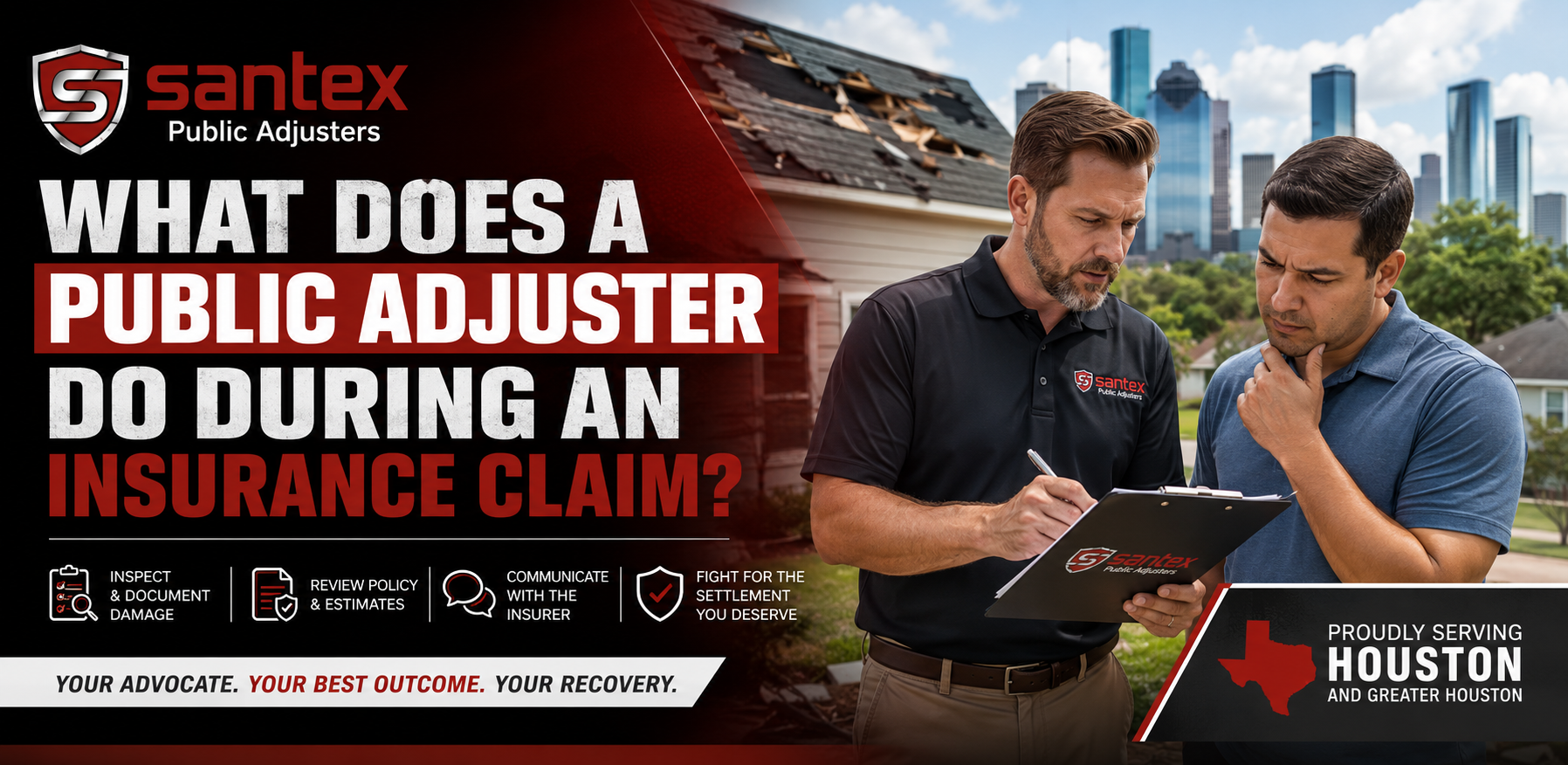
Understanding the Role of a Public Adjuster
- A public adjuster represents the policyholder, not the insurance company.
- Public adjusters help inspect damage, document the loss, review claim paperwork, and communicate with the insurer.
- Their role is especially helpful when a claim is denied, delayed, underpaid, confusing, or difficult to document.
- A public adjuster does not guarantee a settlement or provide legal representation, but they can help support a more complete claim process.
- Santex Public Adjusters helps Houston and Greater Houston policyholders navigate residential and commercial property insurance claims.
After property damage, many homeowners and business owners are surprised by how complicated the insurance claim process becomes. The insurance company may send an adjuster to inspect the property, request documentation, prepare an estimate, and make coverage decisions. But that adjuster works for the insurance company, not for the policyholder.
That is where a public adjuster can help. A public adjuster is hired by the policyholder to help document the damage, organize the claim, communicate claim details, review estimates, and advocate for a complete and accurate evaluation of the loss.
For Houston-area property owners dealing with storm damage, roof damage, fire damage, smoke damage, water damage, or a complicated commercial property claim, the public adjuster’s role can bring structure and clarity to a stressful process.
This guide explains what a public adjuster does during an insurance claim, when one may become involved, what they do not do, and how Santex Public Adjusters helps policyholders throughout Greater Houston.
What Is a Public Adjuster?
A public adjuster is a licensed insurance claim professional who represents the policyholder during a property insurance claim. Unlike an insurance company adjuster, a public adjuster works on behalf of the property owner.
Simple Definition
A public adjuster helps a policyholder document property damage, prepare claim information, communicate with the insurance company, review estimates, and advocate for a complete and accurate claim evaluation.
The most important distinction is representation. The insurance company’s adjuster evaluates the claim for the insurer. A public adjuster helps the policyholder present and support the claim from the property owner’s side.
If you are still comparing the two roles, read Santex’s guide to public adjusters vs. insurance adjusters.
¿Qué hace un Ajustador Público durante una reclamación de seguro?
A public adjuster helps the policyholder throughout the claim process by reviewing the claim situation, inspecting the property, documenting damage, reviewing policy and estimate issues, preparing claim information, communicating with the insurance company, and helping the property owner understand possible next steps.
A public adjuster may help with:
- Reviewing the property damage and current claim status.
- Inspecting visible and potentially hidden damage.
- Reviewing policy-related claim issues such as deductibles, limits, exclusions, and replacement cost concerns.
- Taking photos, organizing documents, and preparing supporting claim materials.
- Reviewing the insurance company’s estimate for missing or undervalued items.
- Communicating with the insurance company about claim-related information.
- Helping with underpaid, denied, delayed, reopened, or supplemental claims.
- Guiding the policyholder through the claim process with a clearer understanding of what may be needed next.
The Public Adjuster Claim Process
1. Review
The public adjuster reviews what happened, what damage occurred, and where the claim stands.
2. Inspect
The property is inspected to identify damage, missing items, and documentation needs.
3. Document
Photos, repair scopes, estimates, records, and supporting information are organized.
4. Communicate
The public adjuster helps communicate claim details and documentation to the insurer.
5. Review Estimate
The insurer’s estimate is reviewed for missing, incomplete, or undervalued items.
6. Guide Next Steps
The policyholder receives guidance on what may be needed to keep the claim moving forward.
Step 1: Reviewing the Claim Situation
A public adjuster usually begins by learning what happened and where the claim stands. This first review is important because every claim starts in a different place. Some homeowners contact a public adjuster before filing. Others call after an insurance inspection, after receiving a low estimate, after a denial, or after weeks of frustrating delays.
During this review, a public adjuster may ask about:
- The date and cause of the damage.
- The type of property involved.
- Whether the claim has already been filed.
- Whether the insurance company has inspected the property.
- Whether the claim has been denied, delayed, or underpaid.
- What repair estimates, photos, letters, or claim documents already exist.
- Whether emergency repairs, mitigation, or temporary repairs have taken place.
This helps the public adjuster understand the claim problem and determine what information may be needed next. For Houston property owners, this review is often the first moment when the claim begins to feel more organized and less overwhelming.
Step 2: Inspecting and Documenting the Property Damage
Documentation is one of the most important parts of a property insurance claim. If damage is not documented clearly, it may be missed, misunderstood, or undervalued during the insurance company’s review.
A public adjuster may inspect and document damage involving:
- Roof damage from wind, hail, storms, or hurricanes.
- Water damage from plumbing leaks, burst pipes, or storm-related intrusion.
- Fire and smoke damage affecting the structure or contents.
- Interior damage to walls, ceilings, flooring, cabinets, insulation, and finishes.
- Commercial property damage affecting buildings, equipment, inventory, or operations.
- Secondary damage that may not be obvious during a quick inspection.
Strong documentation may include photos, videos, measurements, repair scopes, contractor notes, invoices, timelines, inventory lists, and communication records. Santex Public Adjusters helps policyholders organize this information so the insurance company receives a clearer picture of the documented loss.
For a deeper look at this part of the process, visit Santex’s page on claims documentation.
Need Help Understanding Your Claim?
Santex Public Adjusters helps Houston-area policyholders review claim documents, organize damage information, and understand what may be needed next.
Step 3: Reviewing the Insurance Policy and Coverage Issues
Insurance policies can be difficult to understand. They may include deductibles, exclusions, limits, endorsements, replacement cost provisions, actual cash value language, duties after loss, and other claim-related requirements.
A public adjuster can help the policyholder review claim-related policy issues and understand how the policy may affect the documentation and presentation of the claim. This may include reviewing:
- The reported cause of loss.
- Applicable deductibles.
- Coverage limits.
- Exclusions or limitations identified by the insurer.
- Replacement cost and actual cash value issues.
- Policyholder duties after loss.
- Documents or information requested by the insurance company.
A public adjuster is not a substitute for legal counsel. If a claim involves legal questions, policy interpretation disputes, or litigation concerns, the policyholder should consult a qualified attorney. However, for the claim documentation and estimating process, a public adjuster can often help the property owner understand what information the insurer may need and where the claim may be incomplete.
Learn more about Santex’s insurance policy review services.
Step 4: Preparing the Claim Package
A claim package is the organized collection of information used to support the property owner’s claim. The stronger and more complete the claim package is, the easier it is for the insurance company to understand what damage occurred, what repairs may be needed, and what items require review.
A public adjuster may help prepare or organize:
- A description of the loss.
- Photos and videos of damaged areas.
- Repair estimates and scopes of work.
- Contractor reports or mitigation documentation.
- Lists of damaged materials, contents, or building components.
- Insurance company letters, estimates, and claim communications.
- Supplemental information if damage was missed or additional repair needs were discovered.
This is especially important in larger claims, commercial property claims, roof damage claims, water damage claims, and fire damage claims, where a quick inspection may not capture the full scope of the loss.
Step 5: Communicating With the Insurance Company
Insurance claim communication can become stressful quickly. Policyholders may receive requests for documents, questions about damage, estimate explanations, inspection scheduling messages, coverage letters, or settlement paperwork. Many homeowners are not sure what to say, what to send, or what the insurance company’s response actually means.
A public adjuster may help with claim-related communication such as:
- Coordinating inspections.
- Submitting supporting claim documents.
- Discussing estimate items with the insurance company.
- Responding to claim-related information requests.
- Following up on delayed claim activity.
- Helping the policyholder understand what information is still needed.
This support can be valuable because communication gaps often lead to confusion, delays, or incomplete claim evaluations. Santex helps policyholders communicate claim information more clearly while keeping the property owner’s interests at the center of the process.
Visit Santex’s page on claims representation to learn more.
Step 6: Reviewing the Insurance Company’s Estimate
One of the most important things a public adjuster does is review the insurance company’s estimate. A claim estimate may look official and detailed, but that does not always mean it includes every damaged item or reflects the full repair scope.
A public adjuster may review the insurer’s estimate for:
- Missing line items.
- Incorrect measurements.
- Incomplete repair assumptions.
- Damage that was overlooked during inspection.
- Scope differences between the insurance estimate and contractor estimate.
- Material, labor, or access issues that may affect repair costs.
- Depreciation, deductible, or coverage explanations that need clarification.
If the insurance estimate seems too low, a public adjuster may help identify why. The issue may involve missing damage, incomplete documentation, pricing concerns, or differences between what the insurer included and what the repair actually requires.
If your insurance payment does not appear to cover the damage, review Santex’s page on underpaid home insurance claims.
How a Public Adjuster Helps With Claim Problems
Underpaid Claims
A public adjuster may help identify missing damage, incomplete estimate items, or documentation needed to support additional claim review.
Denied Claims
A public adjuster may help review the denial explanation, inspect the damage, and organize claim information so the policyholder can better understand possible next steps.
Delayed Claims
A public adjuster may help organize communication, follow up on claim activity, and clarify what information may still be needed.
Reopened or Supplemental Claims
If additional damage is discovered or repair needs were missed, a public adjuster may help document the issue and organize supplemental claim information.
What Types of Claims Can a Public Adjuster Help With?
Public adjusters commonly assist with residential and commercial property insurance claims. In Greater Houston, these claims often involve severe weather, roof damage, water damage, fire damage, and complex repair scopes.
Storm, Wind, Hail, and Hurricane Damage Claims
Houston-area storms can damage roofs, siding, windows, interiors, detached structures, and commercial buildings. A public adjuster may help document the damage, compare estimates, and organize claim information for storm-related losses. Learn more about storm damage insurance claims.
Water Damage Claims
Water damage claims may involve plumbing leaks, burst pipes, appliance leaks, interior water damage, or storm-related openings. These claims often require careful documentation because hidden damage can develop behind walls, under flooring, or inside building assemblies. Learn more about water damage insurance claims.
Fire and Smoke Damage Claims
Fire and smoke claims can involve structural damage, cleaning needs, smoke odor, contents damage, electrical issues, and temporary living or business interruption concerns depending on the policy and situation. Visit Santex’s pages on fire damage insurance claims and smoke damage insurance claims.
Roof Damage Claims
Roof claims often involve disputes over wind damage, hail damage, wear and tear, repairability, matching, interior leaks, and the scope of necessary repairs. Learn more about roof damage claim help.
Commercial Property Claims
Commercial claims may involve larger buildings, specialized equipment, inventory, tenant improvements, business operations, and more complex documentation. Santex helps business owners review and organize claim information when property damage affects a commercial location.
When Does a Public Adjuster Usually Get Involved?
A public adjuster may become involved at several points in the claim process. The right timing depends on the damage, the claim status, and the policyholder’s concerns.
- Before filing a claim, when the property owner wants help understanding the damage and documentation needs.
- After filing, but before the insurance company inspection.
- After receiving the insurance company’s first estimate.
- After a low settlement offer.
- After a claim denial.
- When repairs reveal additional damage.
- When the claim is delayed or communication has stalled.
- When the claim is large, technical, or difficult to document.
For a deeper timing guide, visit Santex’s page on when to hire a public adjuster.
What a Public Adjuster Does Not Do
A trustworthy public adjuster should be clear about the limits of their role. A public adjuster helps with claim documentation, communication, estimating, and policyholder claim support, but they do not control the insurance company or guarantee the final claim outcome.
A public adjuster does not:
- Work for the insurance company.
- Guarantee a specific settlement amount.
- Force an insurance company to pay a claim.
- Provide legal representation or legal advice.
- Replace the policyholder’s responsibility to cooperate with reasonable claim requirements.
- Make unsupported claims without documentation.
This distinction matters. Santex Public Adjusters focuses on professional, policyholder-centered claim assistance supported by documentation, experience, and clear communication.
Public Adjuster vs. Insurance Company Adjuster
Both public adjusters and insurance company adjusters may inspect damage and review claim information, but they represent different sides of the claim.
| Role | Ajustador público | Insurance Company Adjuster |
|---|---|---|
| Who they represent | The policyholder | The insurance company |
| Who hires them | The property owner | The insurer |
| Main responsibility | Help document and present the policyholder’s claim | Evaluate the claim for the insurance company |
| Common involvement | Complex, denied, delayed, underpaid, or high-value claims | Standard insurer claim handling |
Read the full comparison here: Ajustador Público vs. Ajustador de Seguros: ¿Cuál es la diferencia?
How a Public Adjuster Helps Houston Homeowners and Business Owners
Houston property owners face a wide range of insurance claim challenges. Tropical weather, hurricanes, wind, hail, heavy rain, plumbing failures, fire damage, and roof leaks can create losses that are expensive, technical, and difficult to document.
Santex Public Adjusters helps policyholders throughout Houston and the Greater Houston area, including Deer Park, Pasadena, League City, Pearland, La Porte, Seabrook, Webster, and nearby communities.
The goal is not to make the claim process more complicated. The goal is to help the policyholder understand the damage, organize the claim, communicate clearly, and avoid moving forward without knowing whether the claim has been fully reviewed.
Signs You May Need a Public Adjuster
You may want to speak with a public adjuster if:
- The insurance company’s estimate seems too low.
- Your claim was denied.
- Your claim is taking too long.
- The damage is widespread, technical, or difficult to document.
- The contractor’s estimate is higher than the insurance estimate.
- You are not sure whether all damage was included.
- You do not understand the insurance company’s explanation.
- The insurer says part of the damage is not covered.
- Repairs revealed additional damage.
- You feel overwhelmed by the claim process.
For more detail, read Santex’s guide on signs you may need a public adjuster.
How Much Does a Public Adjuster Cost?
Public adjuster fees can vary depending on the claim, the firm, and applicable rules. Before signing an agreement, policyholders should ask how the fee is structured, what services are included, and when payment is due.
The bigger question is whether the claim is complex enough to justify professional claim assistance. A public adjuster may be especially valuable when the loss is large, the estimate is low, the claim is denied, the claim is delayed, or the documentation is incomplete.
Learn more here: How Much Does a Public Adjuster Cost in Houston?
What to Expect When Working With Santex Public Adjusters
Santex Public Adjusters represents policyholders only. The process is designed to help property owners understand where the claim stands, what documentation may be missing, and what next steps may be appropriate.
- Initial claim review: Santex reviews the damage type, claim status, insurance documents, and current concerns.
- Property and damage evaluation: Santex helps assess visible damage and identify areas that may require additional documentation.
- Claim documentation: Santex helps organize photos, estimates, reports, records, and claim-related documents.
- Insurance communication support: Santex helps policyholders communicate claim information more clearly with the insurer.
- Estimate and settlement review: Santex reviews the insurer’s estimate for missing, incomplete, or disputed items.
- Next-step guidance: Santex helps the policyholder understand what may be needed next, whether that involves additional documentation, a supplemental claim review, or further claim assistance.
Common Mistakes Homeowners Make Without Claim Help
Many claim problems begin with simple mistakes. A policyholder may assume the insurance estimate includes everything, accept the first offer without review, or begin repairs before documenting the damage.
Common mistakes include:
- Failing to photograph all damaged areas.
- Throwing away damaged materials too soon.
- Not keeping copies of claim emails, letters, and estimates.
- Accepting the first estimate without comparing it to repair needs.
- Missing documentation requests or deadlines.
- Assuming hidden damage will be discovered automatically.
- Starting repairs before the damage is properly documented.
- Waiting too long to ask for help after a claim problem appears.
A public adjuster helps reduce these risks by bringing structure, documentation, and claim experience to the process.
A Public Adjuster Helps You Navigate the Claim Process
If your insurance claim is confusing, delayed, denied, underpaid, or difficult to document, Santex Public Adjusters can help you review the situation and understand what may be needed next.
Preguntas Frecuentes
¿Qué hace un ajustador público?
A public adjuster helps policyholders document property damage, prepare claim information, communicate with the insurance company, review estimates, and advocate for a complete and accurate claim evaluation.
Does a public adjuster work for the insurance company?
No. A public adjuster represents the policyholder, not the insurance company.
When should I call a public adjuster?
You may want to call a public adjuster if your claim is denied, delayed, underpaid, confusing, complex, or involves significant property damage.
Can a public adjuster help after the insurance company already inspected my property?
Yes. A public adjuster may still be able to review the insurance estimate, inspect the damage, identify missing items, and help organize additional claim documentation.
Can a public adjuster help with a denied insurance claim?
A public adjuster may help review the denial explanation, document the damage, organize claim information, and help the policyholder understand possible next steps.
Can a public adjuster help with an underpaid insurance claim?
Yes. Public adjusters often help policyholders review low estimates, identify missing damage, and prepare supporting documentation for additional claim review.
What types of claims do public adjusters handle?
Public adjusters may help with storm damage, fire damage, smoke damage, water damage, roof damage, hurricane damage, commercial property damage, and other property insurance claims.
Is hiring a public adjuster worth it?
It depends on the size, complexity, and condition of the claim. A public adjuster may be especially valuable when the claim involves major damage, a low estimate, a denial, a delay, or unclear documentation.
How much does a public adjuster cost?
Fees can vary depending on the claim and the public adjusting firm. Policyholders should ask how fees are structured before signing an agreement.
Does Santex Public Adjusters help Houston homeowners?
Yes. Santex Public Adjusters helps Houston and Greater Houston policyholders with insurance claim assistance, documentation, claim review, and policyholder representation.

