
Texas Property Insurance Claim Guide
What Is Recoverable Depreciation on a Home Insurance Claim in Texas?
You received the insurance company’s estimate, but the check is lower than the total amount shown for repairing or replacing your damaged property. Somewhere in the paperwork you may see terms such as replacement cost value (RCV), actual cash value (ACV), depreciación, and recoverable depreciation.
That difference can be confusing. A lower initial payment does not necessarily mean every unpaid dollar has been permanently denied. Depending on your insurance policy and the circumstances of the claim, the insurance company may have withheld depreciation that can potentially become payable after you satisfy the policy’s replacement-cost requirements.
This guide explains what recoverable depreciation means, why it may be withheld, how the recovery process commonly works, what documentation may matter, and what Texas property owners should review before assuming the first insurance check represents the final amount available under the claim.
Quick Answer: What Is Recoverable Depreciation?
Recoverable depreciation is depreciation that an insurance company has withheld from an initial property-claim payment but that may be payable later when the policyholder satisfies the applicable replacement-cost provisions of the insurance policy. Whether depreciation is recoverable, how much can be recovered, what documentation is required, and when it must be requested depend on the policy and the individual claim.
Before You Assume Money Is Missing
Recoverable depreciation is only one part of a property-claim calculation. Your deductible, policy limits, coverage provisions, exclusions, repair requirements, claim valuation, and other adjustments can also affect the amount paid. Review the estimate together with the policy and settlement correspondence rather than looking at a single number in isolation.
Why Do Insurance Companies Apply Depreciation to Property Claims?
Many building materials and personal property items lose value as they age or experience normal wear. A roof that has already been in service for many years, for example, is not necessarily valued the same way as a brand-new roof.
When depreciation is part of the claim calculation, factors that may be considered can include:
- The age of the damaged property or building component.
- Its condition immediately before the covered loss.
- The type of material or property involved.
- Its expected useful life.
- The valuation method permitted by the applicable policy.
The way depreciation is calculated can vary. That is why reviewing the actual insurance estimate and the policy provisions is more useful than relying on a generic percentage or rule of thumb.
ACV vs. RCV: Two Terms You Need to Understand
What Is Replacement Cost Value (RCV)?
Replacement cost value generally refers to the estimated cost of repairing or replacing covered damaged property with property of comparable kind and quality, subject to the insurance policy’s limits, conditions, exclusions, and other terms.
What Is Actual Cash Value (ACV)?
Actual cash value is a claim-valuation concept that may reflect depreciation. The exact definition and method of calculating ACV can depend on the policy and circumstances, so homeowners should review the policy rather than assuming every carrier calculates it in precisely the same way.
A Simplified Example
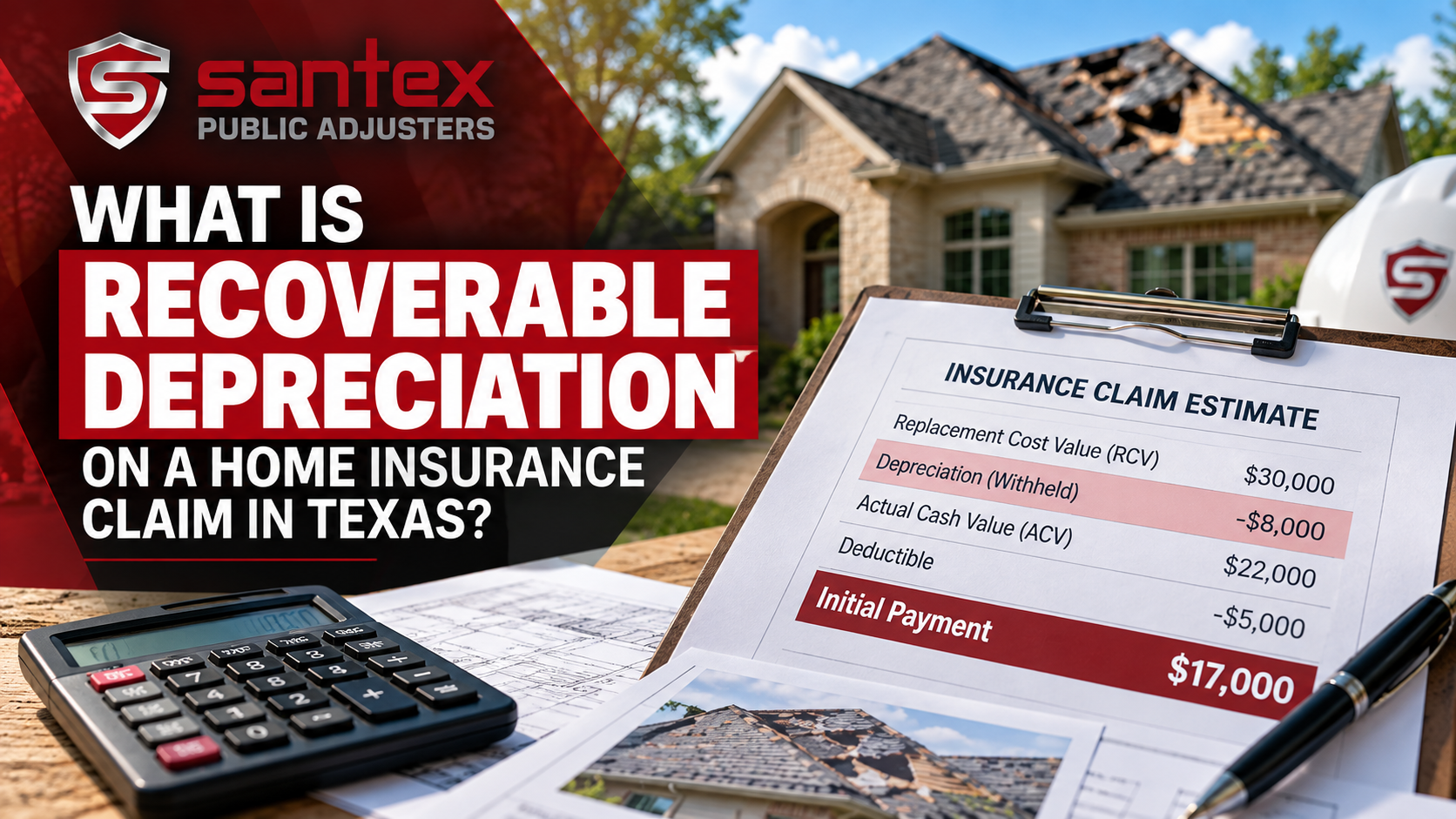
| Claim Calculation | Illustrative Amount |
|---|---|
| Replacement cost estimate | $30,000 |
| Less depreciation | -$8,000 |
| Illustrative actual cash value | $22,000 |
| Less deductible | -$5,000 |
| Illustrative initial payment | $17,000 |
Importante: This example is intentionally simplified and does not represent how every Texas insurance claim will be calculated. Policy language and individual claim circumstances control.
Recoverable vs. Non-Recoverable Depreciation
Recoverable Depreciation
Recoverable depreciation generally refers to depreciation withheld from an initial claim calculation that may become payable once the requirements for replacement-cost coverage have been satisfied.
Non-Recoverable Depreciation
Some depreciation may not be recoverable under the applicable policy or coverage. Seeing a depreciation figure on an estimate does not, by itself, mean the entire amount must eventually be paid.
Where Should You Look?
Review the estimate, settlement letter, policy, and payment explanation for language such as:
- Replacement Cost Value or RCV
- Actual Cash Value or ACV
- Depreciación
- Recoverable Depreciation
- Non-Recoverable Depreciation
- Net Claim or Net Payment
If those terms are difficult to reconcile, a detailed
Examen de la política de seguros
can help identify which policy provisions apply to the claim.
Why Did My Insurance Company Withhold Depreciation?
Under some replacement-cost claim structures, payment occurs in stages. The insurance company may initially issue a payment based on an ACV calculation and then consider additional replacement-cost benefits after applicable repair, replacement, documentation, and policy requirements are satisfied.
This is one reason the first check may be lower than the total replacement-cost estimate. It does not automatically mean the remaining amount is owed, nor does it automatically mean the claim is underpaid. The next step is to determine exactly what the estimate and policy say.
How Do You Get Recoverable Depreciation?
There is no single procedure that should be assumed to apply to every claim. Your insurance policy and carrier correspondence should control the process. In general, the following steps can help you understand what may be required.
1. Review the Insurance Company’s Estimate
Identify the RCV, depreciation, ACV, deductible, net payment, and any amount specifically labeled recoverable or non-recoverable.
2. Review the Replacement-Cost Conditions
Read the applicable policy provisions and claim correspondence carefully. Repair requirements, replacement requirements, notice provisions, documentation requirements, and time limits may affect whether additional amounts can be recovered.
3. Keep Detailed Documentation
Depending on the claim, useful records can include:
- Estimaciones de contratistas
- Signed contracts
- Invoices
- Receipts
- Proof of payment
- Photographs of repairs
- Completion documentation
- Correspondence with contractors and the insurance company
Santex also has a dedicated resource on
documentación de la reclamación de seguros
and a homeowner guide explaining
what documents may be needed for an insurance claim
.
4. Submit the Information Required by the Policy and Carrier
Completing repairs does not necessarily cause an additional payment to be issued automatically. Follow the procedure identified in your policy and claim correspondence and retain copies of what you submit.
5. Review the Additional Payment Carefully
Compare the original estimate, the amount shown as potentially recoverable, the documentation you submitted, and the insurer’s additional payment explanation. If they do not appear to line up, determine the insurer’s stated reason before deciding what to do next.
Need the Bigger Picture?
Recoverable depreciation is only one stage of a property claim. For a broader explanation, see Santex’s
step-by-step guide to the Texas insurance claim process
or review Santex’s
claims process assistance
.
How Long Do You Have to Claim Recoverable Depreciation in Texas?
Do not assume that one universal deadline applies to every Texas property claim. The relevant timing can depend on your insurance policy, endorsements, claim circumstances, repair or replacement provisions, correspondence from the insurer, and other applicable requirements.
Review your policy and claim correspondence promptly. If you are unsure which provision controls, do not wait until repairs are complete to investigate the deadline.
What Happens If You Don’t Make the Repairs?
Where replacement-cost benefits are conditioned on repair or replacement, failing to satisfy those conditions can affect whether withheld depreciation becomes payable.
It helps to separate two different questions:
- Was the insurance company’s original claim valuation correct?
- Have the conditions for receiving additional replacement-cost benefits been satisfied?
Those are not necessarily the same issue. A disagreement about repair scope or claim value can exist separately from the process for recovering depreciation.
What If the Actual Repair Cost Is Higher Than the Insurance Estimate?
Recoverable depreciation should not be confused with a disagreement about the amount or scope of the loss.
A claim can involve several separate issues, including:
- Withheld depreciation.
- Additional covered damage identified after the initial inspection.
- Differences in repair scope.
- Differences in quantities or measurements.
- Additional documented repair costs.
- Other disagreements concerning claim valuation.
Recovering depreciation does not automatically resolve a separate dispute about whether the claim was valued correctly. If the broader issue is an insufficient claim payment, review Santex’s guidance on an
underpaid insurance claim in Texas
or its
underpaid home insurance claim assistance
.
Recoverable Depreciation vs. an Insurance Claim Supplement
These terms are sometimes discussed together, but they describe different claim issues.
Recoverable depreciation concerns depreciation withheld from a claim payment that may become payable under applicable replacement-cost provisions.
A supplemental claim request generally concerns additional claimed amounts or supporting information submitted after an initial claim estimate, such as when additional covered work or costs are identified. Both issues may arise during the same claim, but one is not simply another name for the other.
Common Recoverable Depreciation Mistakes to Avoid
- Assuming every dollar of depreciation is automatically recoverable.
- Ignoring the policy’s replacement-cost provisions.
- Waiting too long to investigate repair, replacement, notice, or documentation requirements.
- Discarding contractor estimates, invoices, receipts, photographs, or proof of payment.
- Assuming the first check represents every amount that may become payable under the claim.
- Confusing depreciation with the deductible.
- Confusing recoverable depreciation with a supplemental claim request.
- Failing to review the insurer’s explanation when an additional payment differs from what you expected.
Example: How Recoverable Depreciation Could Work After Roof Damage
Consider a simplified example in which a covered storm damages a roof and the policy provides applicable replacement-cost coverage:
- The homeowner reports the loss.
- The insurance company inspects and prepares an estimate.
- The estimate identifies the replacement cost and calculates depreciation.
- The insurer issues an initial payment based on its claim calculation, less the applicable deductible and other adjustments.
- The homeowner completes qualifying repairs and keeps the required documentation.
- The homeowner submits the documentation in accordance with the policy and carrier’s requirements.
- The insurer reviews whether an additional replacement-cost payment is owed.
This is an educational illustration only. The actual process, coverage, valuation, documentation, and timing can differ from claim to claim.
When Is It Worth Having the Claim Reviewed?
Seeing recoverable depreciation on an estimate does not automatically mean something is wrong. A closer review may make sense, however, when the claim documents do not clearly explain the payment or when a broader disagreement exists.
Consider seeking professional claim guidance when:
- You cannot reconcile the insurer’s estimate with the payment you received.
- It is unclear which depreciation is recoverable.
- Covered damage appears to be missing from the estimate.
- The repair scope differs substantially from what contractors are finding.
- You submitted documentation but there is still a payment dispute.
- You do not understand which replacement-cost conditions remain outstanding.
- The broader claim may have been underpaid.
Los Ajustadores Públicos de Santex representan
de políticas
in property insurance claims. Learn more about
cuándo contratar un ajustador público
and how claim representation may fit your situation.
Escuchamos. Planeamos. Recupera.
Not Sure What Your Insurance Estimate Actually Pays For?
If the depreciation, settlement calculation, or remaining claim balance is difficult to understand, Santex can review the claim documents and help you identify the questions that need to be answered.
Frequently Asked Questions About Recoverable Depreciation
What does recoverable depreciation mean on an insurance claim?
It generally means depreciation that was withheld from an initial claim payment but may become payable if the policyholder satisfies the applicable replacement-cost conditions of the insurance policy.
Is recoverable depreciation the same as my deductible?
No. A deductible is the portion of a covered loss applied according to the policy. Depreciation relates to the valuation of damaged property. They are separate parts of a claim calculation.
Why is depreciation withheld from an insurance payment?
Under some replacement-cost claim structures, an insurer may initially calculate payment using an actual-cash-value amount and consider eligible withheld depreciation after applicable repair, replacement, documentation, and policy requirements have been met.
Do I automatically get recoverable depreciation back?
Not necessarily. Whether the amount is payable depends on the insurance policy, whether applicable conditions have been satisfied, and the circumstances of the claim.
How do I request recoverable depreciation?
Review your policy and claim correspondence for the insurer’s requirements. The process may involve completing covered repairs or replacement and submitting required documentation such as invoices, receipts, contracts, proof of payment, or completion records.
Do I need receipts to recover depreciation?
Documentation requirements vary by policy and claim. Receipts, invoices, contracts, photographs, proof of payment, or other repair documentation may be relevant. Follow the requirements stated in your policy and claim correspondence.
How long do I have to claim recoverable depreciation in Texas?
Do not assume one deadline applies to every Texas claim. Timing can depend on the policy, endorsements, claim circumstances, repair or replacement provisions, and correspondence from the insurer. Review those documents promptly.
Can depreciation be applied to a roof insurance claim?
Depreciation may be part of a roof claim valuation depending on the coverage, policy language, age and condition of the roof, and other claim circumstances.
What if my contractor’s repair cost is higher than the insurance estimate?
That may involve a separate issue from recoverable depreciation. Differences in scope, quantities, additional damage, or documented repair costs may need to be evaluated independently from withheld depreciation.
What if my recoverable depreciation payment seems too low?
Compare the original estimate, the depreciation identified as potentially recoverable, your repair documentation, the applicable policy provisions, and the insurer’s payment explanation. If the numbers still do not reconcile, a claim review may help clarify the disagreement.
Understand the Claim Before You Accept the Numbers
Recoverable depreciation can look like a simple line item, but it sits inside a larger claim calculation involving valuation, policy terms, documentation, deductibles, repair scope, and settlement requirements.
Santex Public Adjusters helps property owners understand and document complex property claims. If you are uncertain whether the payment accurately reflects the covered loss, you can also review Santex’s
insurance settlement assistance
y
Houston public adjuster services
.

